Thursday, August 16, 2012

Know More About The Panada

The panda, or more accurately known as the Giant Panda is a true bear native to central-western and south western China. It is easily recognizable by its large, distinctive black patches around the eyes, over the ears, and across its round body.
The western world first learned of the giant panda in 1869 when the French missionary Armand David received a skin from a hunter on 11 March 1869. The first living giant panda to be seen outside China was by the German zoologist Hugo Weigold, who purchased a cub in 1916. In 1938, five giant pandas were sent to London, but no more to follow for the next half of the century due to the Second World War and its repercussions.
Panda Facts
The giant panda is an endangered species because it is threatened by continued habitat loss and by a very low birthrate, both in the wild and in captivity. Furthermore, the giant panda has been a target for poaching by locals since ancient times and then by foreigners since it was introduced to the West. Thankfully, starting in the 1930s, foreigners were unable to poach giant pandas in China because of the Second Sino-Japanese War and the Chinese Civil War, but pandas still remained a source of soft furs for the locals. The population boom in China after 1949 created further stress on the pandas' habitat, and the subsequent famines led to the increased hunting of wildlife, including the Giant Pandas.
Worse was to come because during the Cultural Revolution, all studies and conservation activities on the pandas were stopped. Then after the Chinese economic reform, demand for panda skins from Hong Kong and Japan led to illegal poaching for the black market - acts which were generally ignored by the local officials at the time.
The Wolong National Nature Reserve was set up by the PRC government in 1958 to save the declining panda population, but few advances in the conservation of pandas were made, due to inexperience and insufficient knowledge of Giant Panda ecology. Many believed that the best way to save the pandas was to cage them. As a result, pandas were caged at any sign of decline, and suffered further from the terrible conditions. Because of pollution and destruction of their natural habitat, along with segregation due to caging, reproduction of wild pandas was severely limited. But things began to change in the 1990s, when several laws (including gun control and the removal of resident humans from the reserves) helped the chances of survival for pandas. With these renewed efforts and improved conservation methods, wild pandas have started to increase in numbers in some areas, even though they still are classified as a rare species.

Friday, August 10, 2012

We All Need To Do Something To Protect Wild Tiger

There are millions of kinds of animals on the earth, and quite a lot of them are rare, with so much hurt to them, the numbers of animals are reducing now, especially the rare wild animals. Recently, I have been really disturbed by the plight of the wild tiger, the largest of all cats, and one of the most threatened species on earth.

Moreover, having grown up in South Africa, living on a farm and around game and nature reserves, animal conservation has always been an issue close to my heart. I hate to see an animal suffering or in need, and I cannot tolerate the endangerment of any animal species or habitats by irresponsible or destructive human behavior.


I started looking for a way to do something to help save these beautiful cats, and in the process I found some really great organizations doing amazing work for these animals. I hope that by sharing this information and supporting these organizations, I can do my small bit to help protect the majestic tiger.

Right now, we face the very real danger that we could lose the wild tiger. Their very survival is threatened by growing human populations, poaching (of both tigers and their prey species), illegal wildlife trade, and the loss of over 90% of their habitat. A century ago there were 100,000 tigers roaming the forests, swamps, and tundra of Asia. Today, there are as few as 3,200 left in the wild, and only 7% of historic tiger habitat still contains tigers. At this rate, wild tigers will be extinct in just a few decades.

We can save wild tigers. And by saving tigers, we also save the biologically rich and diverse landscapes where they still roam – Asia’s last great rain forests, jungles and wild lands.

WWF (World Wildlife Fund), the world’s leading conservation organization, has been helping to ensure the survival of wild animals all around the globe for over 50 years. You can support them by taking part in their Adopt a Tiger program. Save Tigers Now, a global campaign by WWF and Leonardo DiCaprio, aims to build political, financial and public support to double the number of wild tigers by 2022, the next Year of the Tiger. You can donate to the campaign to help save tigers in the wild. Save the Tiger Fund (STF) and Panthera have joined together in the fight to save tigers in the wild. You can contribute to the STF-Panthera Fund to help ensure that tigers will live on in the wild forever.

Friday, August 3, 2012

How Necessary Are The Outfits For Your Pet Dog

How do you think you're supposed to look after the merchandise? Does it call for specific laundering or is it a basic subject of throwing it into your washing machine? Check out to discover if your item must be hung dry or if it can be thrown into your dryer. Bear in mind that selected detergents could irritate your dog's skin so be aware of that when launder the apparel your select.

You don't have to restrict on your own to dressing your pet dog up only while in the winter. Many house owners have adorable t-shirts as well as other light-weight clothing for the warmer months. Spring would be the best period for light-weight puppy apparel. The moderate temperatures allow for them to wear different types of clothes with none discomfort.

Some tiny dogs tend to be more liable to the cool climate than much larger breeds. For example, Chihuahuas and Yorkshire Terriers are merely not tailored to live in chilly weather conditions, and as a result, we need to assist continue to keep them heat and safe and sound with apparel. A simple sweatshirt can establish a precious tool in achieving this.

Will you be searching for an merchandise which is for just a big day? The precise occasion or need to have will allow you to decide just whatever you want to acquire. Maybe you’d like a jersey to your favored football group to decorate your buddy up in time to the Super Bowl, or possibly you’re celebrating a household wedding ceremony as well as your dog might be incorporated. Whichever the special day, you’ll be able to rest assured you are going to be in a position to locate something which is simply correct and will fit your tastes and your dog’s demands.

If you reside in a cold local weather region, you’ll want to normally have a wardrobe available in your pet to have on. Even if it is really merely a sweater and jacket,dog apparel, you will probably obtain you working with it quite` normally that can help preserve your canine warm during the cold. For destinations by using a large amount of snow, a weather-proof raincoat is important to keep your dog protected from the freezing snow and rain.

When most people think about pet dog attire,puppy apparel, they consider cute Chihuahuas using lovely and stylish gowns or outfits. Whilst dog outfits do offer type and attractiveness,dog clothes, also they are significant for any number of other explanations. Right here,Large Dog Clothes, we will require a look at some of these reasons and reveal when dog attire are unquestionably needed.

An frequently neglected item is puppy sneakers. Certainly you observed me effectively, they make sneakers for dogs. Although a lot of people will brush this item off to be a unneeded commodity, they are really terrific for safeguarding your dogs sensitive paws. When it is raining or snowing outside the house, the freezing, slippery ground can verify risky and tough for a dogs paws. Very simple booties and footwear will help secure their paws by delivering a protecting layer of snug product. If you make your mind up on buying pet dog footwear, be sure to find types that conform for your pet dogs paws and aren’t stiff.

Wednesday, July 25, 2012

Do You Know These Facts About The Eastern Wild Turkeys

Turkey is the necessary part in our Thanksgiving Dinner, it always has the significant meaning. Large and awkward eastern wild turkeys inhabit much of the continental United States from the Canadian border to the Mexican border. Although the birds were once hunted and their populations decimated in states such As New Hampshire, the wild turkeys have made a comeback because there is even the limited hunting seasons in most eastern states. The birds inhabit all of the northeastern states and it is normal during spring and fall seasons to see large flocks in fields and along roadsides. The wild turkey is an impressive bird when seen on the ground and also in flight. There are many interesting facts to know more about the wild turkeys that inhabit the woods of the United States.

1. Nearly Extinct in the mid 1900s

In the 1930s the population of wild turkeys was very small, wild turkeys have suffered from many years of over hunting and the destruction of their natural habitat. These two factors led to a rapid drop in the population around the country. Turkey hunts were often times fruitless as there simply ere no birds to be found in the woods and fields of the northeast. In the state of New Hampshire during the 1950s and 1960s it was believed that there were no wild turkeys living in the state at all. Throughout New England the turkey populations were very small. The birds became protected and with the establishment and passage of the Pittman-Robertson Act in 1937 funds became available to restore habitats and reintroduce turkey populations to the northeast. The astern Wild Turkey began to reappear in New Hampshire in the 1970s.

2. Natural Protection

The body of a male wild turkey is normally covered in 5,000 to 6,000 feathers. These feathers are patterned in a way that provides natural camouflage for the birds. The feather tracts on the birds allow them to easily blend in with the foliage. The coloration of the feathers in iridescent brown and gold hues blend in with underbrush and leave coverings to make them hard to spot by predators. Even with the large size of a male they can easily blend into forest habitats.

3. Mating Season

During the spring wild turkeys go through a mating ritual. This is when they are normally viewed in fields and along roadsides in New England. These birds prefer large open spaces for the mating rituals. Once they have mated the hen will normally lay 10 to 12eggs. Eggs are laid one a day over a two week period and then incubated for 28 days.

4. Male Turkeys

The typical male turkey weighs around 20 pounds and is distinguished by his fan tail, caruncle, snood and dewlap. Both males and females may have a beard, growth of feathers on the chest area.

5. Diet

Wild turkeys are omnivores, they eat both plants and meats. The normal diet is approximately 90% wild seeds and berries and 10% other items that may include small insects or other fleshy items.

6. Flight

Turkeys are capable of flight and can land in tight spaces. They seem rather awkward when taking off or landing and this is mainly because of their large size. Turkeys do not normally fly long distances.

7. Winter Habitats

Turkeys are not migratory and will remain in their habitats through the winter. Finding small areas where seepage occurs and there is some plant life will provide turkeys with forage for the winter months. Woodlands and forests provide protection form winter’s harshest elements.

Tuesday, May 22, 2012

Hispid Hares Are Among Those Shy And Secretive Mammals


The hispid hare is also called the "bristly rabbit" because it has coarse, dark brown hair. It's ears are short, and its back legs are not much larger than the front legs. It weighs about 2.5 kg (5.5 lb). It prefers tall grass-scrubsavanna, in flat, well-drained and thinly forested country. It is notgregarious, but sometimes lives in pairs. Its diet consists mainly of bark, shoots and roots of grasses, including thatch species, and occasionally crops.
  
Hispid Hare
The hispid hare was formerly found from Uttar Pradesh to Assam (India) along the Himalayan foothills, and south to Dacca in East Pakistan (nowBangladesh). In 1964, it was feared by some to be extinct, or nearly so, but by 1966 it was thought still to exist in a few isolated parts of its range along the foothills of the Himalayas in Uttar Pradesh, Bihar, West Bengal and Assam. In 1990 the areas from which it had been recently recorded included Assam, northwest Bengal, northwest Bihar, Madhya Pradesh, Uttar Pradesh, and theteraiarea of southern and southwestNepal.
  
The main reasons for its decline include habitat loss, mainly for cultivation, forestry, grazing and the burning of thatch; human settlement; hunting for food and to protect crops; and predation by dogs. In addition, human-induced changes in seasonal flooding have favored the later stages of vegetationsuccessionwhich the hispid hare does not prefer.
  
Hispid Hare is widely found in Uttar Pradesh, Bihar, Madhya Pradesh, West Bengal and Assam. They are also spotted at Manas National Parkand Jaldapara Wildlife Sanctuary in West Bengal.
  
Habitat : Hispid Hare prefers low grassy areas to live.
  
Diet : Hispid hare is herbivorous animal and feeds on bark, shoots, grass roots and crops.
  
Reproduction : Gestation period rests for 25- 50 days. Litter size is 2-5 , with possibly 2- 9 litters per year. Young ones are usually born between January  to March.
  
The current status, distribution, habitat use and existing threats to the endangered hispid hare (Caprolagus hispidus) in the Royal Suklaphanta Wildlife Reserve, Nepal, were investigated. The population density of hispid hare recorded in the study area was 1.01 animals/ha. Hispid hare pellets were found in the following grassland sites: Suklaphanta, Barkaula and Piparia. Hispid hare showed zero preference for short grassland, riverine forest and broadleaved forest. Grass species composition was similar in short grassland and tall grassland, but no pellets were found in the short grassland during the study period. This indicates that hispid hares select habitats that provide both shelter and food. The exiting threats to hispid hare were fire, invasion of grass species by broadleaved trees, grazing, flood, predation, and thatch collection.
  
Now, sporadically found in Bangladesh, India, Nepal and possibly Bhutan, it was at one time widely distributed along the foothill region of the southern Himalayas from Uttar Pradeshthrough southern Nepal, the northern region of West Bengal toAssam and into Bangladesh.
  
A significantly large number is found in the extensive grasslands of Sukla Phanta Wildlife Reserve. It prefers tall grasslands, thinly forested country and takes refuge in marshy areas or grass adjacent to river banks during the dry season, when these areas are susceptible to burning.

Friday, May 4, 2012

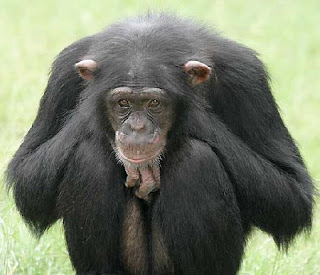
Chimpanzees Are The Closest Species To Mankind


Chimpanzee
Humans and chimpanzees are believed to share a common ancestor who lived some four to eight million years ago. Like human beings they are bestowed with intelligence and are social, noisy and curious. They share more than ninety eight percent of our genetic material. The number of chimpanzees in the world is estimated to be between 100,000 and 200,000. Chimpanzees live in social groups of several dozen animals.

Although they normally walk on all fours, chimpanzees have the ability to stand and walk upright. When standing Chimpanzees are around 1.52m in height. Its weight is usually in the range of 29 to 54 kg. Chimpanzees have very long arms surprisingly longer than the legs, and a short body covered with black hair except on the face, fingers, palms, armpits, and bottoms of their feet. Adult chimpanzees have a short, white beard. By swinging from branch to branch they can also move quite well in the trees, where they do most of their eating. Chimpanzees usually sleep in the trees as well on nests of leaves. They can live up to the age of 50 in the wild, but have been recorded to reach up to the age of 60 in captivity.

Chimpanzees are one of the rare animal species that use tools. They use sticks to retrieve insects from their nests. They also use stones to smash open hard nuts. Chimpanzees have been taught to use some basic human sign language. Chimpanzees are omnivores and feed on both plants and meat. They search for food in the forests during the day - fruits, flowers, leaves, seeds, tree bark, plant bulbs and tender plant shoots. Their diet also consists of termites, ants, and small animals. Chimpanzees drink water, often by using a chewed leaf as a sponge to absorb the water. When faced by a predator, chimpanzees will scream loudly and use any object they can get against it. The leopard is the chimpanzee's main predator, though there have been instances of lions devouring them.

Females attain the reproductive age at thirteen, while males are at sixteen years old. The female’s gestation period is between 7.5 to 8 months. Females can give birth at any time of year, typically to a single baby chimpanzee that clings to its mother's fur and later rides on her back until the age of two. Young chimps may stay with their mothers till they are ten years old.

The greatest concentration of chimpanzee populations is present in the rain forest areas on what used to be known as the equatorial forest ‘belt’ - stretching across Central Africa. They like to live in hot and humid climate. They are usually found in dense tropical rainforests but can also be found in woodlands, bamboo forests, swamps, and open savannah. While chimpanzees spend equal time on land and in trees, they do most of their eating and sleeping in trees.

It is present in West and Central Equatorial Africa. Chimpanzees are found in twenty-one African nations. Congo, Angola, Senegal, Tanzania and Sierra Leone are a few of the countries it inhabits. Only 10 countries have chimpanzee populations more than 1,000. They are in abundance along the river Zaire. Habitat destruction is the greatest threat to its existence. Hunting and commercial exportation are also blamed for their declining numbers.