Wednesday, July 15, 2015

Lose the puppy fat: study has a bone to pick with Crufts' dumpy dogs

Basset hounds at Crufts earlier this year. The breed is one of those most likely to be overweight. Photograph: Oli Scarff/AFP/Getty Image
The pampered pooches on show at Crufts are billed as the finest doggie specimens – but one in four is overweight, research has revealed.

Analysing 960 images of 28 different breeds of adult dogs placed between first and fifth in their class between 2001 and 2013, researchers found just over a quarter were overweight.

And widespread dissemination of pictures from the world’s largest dog show may be normalising obesity in the animals, the study published in the journal Veterinary Record said.

Pugs, basset hounds, and labrador retrievers were the breeds most likely to be too chubby, with 80% of pugs analysed by the researchers found to be overweight. All three of those breeds are renowned for being prone to obesity.

Pugs were originally bred to be a companion dog, but basset hounds and labradors were bred for hunting and fieldwork respectively, so being larger would not be advantageous, according to the researchers.

Labradors were originally used for hunting and fieldwork, so like this pair at Crufts their ideal weight should reflect this. Photograph: David Sillitoe for the Guardian

Overweight dogs can suffer limited lifespans and are more prone to diabetes, breathing problems and orthopaedic issues, as well as certain cancers.

Standard poodles, border terriers, Rhodesian ridgebacks, Hungarian vizslas and dobermanns were the least likely to be overweight. None were underweight, which the researchers said suggested “judges are more aware of the characteristics associated with underweight condition”.

Obesity among show dogs is, perhaps unsurprisingly, less prevalent than in ordinary pet dogs. But researchers said it was still a cause for concern that 26% of dogs at Crufts appear to be above their ideal weight.
Labradors were originally used for hunting and fieldwork, so like this pair at Crufts their ideal weight should reflect this. Photograph: David Sillitoe for the Guardian
“These dogs showcase the ideal characteristics of the pedigree breed, and there is a danger that widespread media exposure might adversely influence owner perception of optimal body shape,” the report said.

“Given the proportion of show dogs from some breeds that are overweight, breed standards should be redefined to be consistent with a dog in optimal body condition,” its authors suggested.

The Kennel Club, which runs Crufts, said its new judging criteria had policies to emphasise the importance of good canine health, including weight.

“Further effort is now required to educate owners, breeders and show judges so that they can all better recognise overweight condition, thus helping to prevent the development of obesity,” the organisation said.

Monday, July 6, 2015

Poachers shift to hornbills as rare animals decline

Because of decreasing numbers of rare wildlife species in Mount Leuser National Park (TNGL), located in North Sumatra and Aceh provinces, poachers have recently started catching the rangkong, or hornbill.
“Hornbills are currently being targeted by poachers because they are rare and hard to catch, partly because their population is further declining,” TNGL center head Andi Basrul told The Jakarta Post on Monday. Basrul said the hornbill was highly valued on the black market, and was being sought by poachers only as of this year. He added that based on the accounts of poachers arrested by officers, the price of a hornbill beak was around Rp 9 million (US$690), or Rp 90,000 per gram. Basrul said officers confiscated 12 hornbill beaks, which had been cleaned and prepared for sale overseas, from the two poachers. He said poaching suspects could face five years in prison and be fined Rp 100 million in accordance with Law No. 5/1990, which covers the conservation of natural resources and ecosystems. Meanwhile, a suspect who traded in hornbill beaks, Jamas, 37, said he had only recently traded in the bird. Jamas said that he used to poach other animals, including elephants and tigers, in TNGL. However, as the endangered animals became harder to find, Jamas said that he switched to trading hornbills. According to the Wildlife Conservation Society’s Indonesia Program, the population of rare animals in the park, including Sumatran tigers, rhinos, elephants and orangutans, has continuously decreased over the last 20 years.

Wednesday, July 1, 2015

Florida law threatens jail for falsely sneaking pet around as service animal

People who try to sneak their pets into restaurants, airplanes and other public places by claiming they are specially trained service animals could face 60 days in jail under a Florida law taking effect on Wednesday.
Falsely claiming your pet is a guide dog could land you in jail under a new Florida law. Photograph: Guide Dogs for the Blind Association/PA

Under the law, judges could also make the pet owners spend a month working with organizations serving people with real disabilities.

“I love my cat,” said Florida state representative Jimmy Smith, a Republican who sponsored the legislation. “But I’m not taking my cat everywhere I go.”
Smith said some pet owners are abusing the Americans with Disabilities Act by putting a guide dog harness or insignia on their animals and taking them into places that normally bar animals.

Pet owners can easily obtain service animal vests and registration documents, even for untrained pets, by sending as little as $75 to otherwise legitimate training facilities.

“To imply that you have a medical or service animal defrauds those who really need their service animals,” Smith said.

Smith noted that some service animals are trained to sense impending seizures or other conditions such as trauma that do not meet the eye, as well as more traditional duties helping the blind and deaf.

He said some restaurants, hotels and other public facilities turn away people with guide dogs if the patrons are not blind or do not have other readily apparent disabilities.

In addition to a 60-day jail term, Smith’s bill provides for offenders to perform 30 hours of community service for an organization that serves people with disabilities.

Tuesday, June 23, 2015

Palm Beach County OKs animal control rules

Palm Beach County Commissioners on Tuesday passed a range of animal control rules, key among them a tougher dog leash law and a spay-
                                                     
and-release plan for cats that some wildlife groups will lead to even more deaths of birds and small animals.

The vote was 6-0; County Mayor Shelley Vana was absent.

At its May 19 meeting, the commission tentatively adopted several new rules for animal control as part of “Countdown 2 Zero,” an ambitious program to reduce euthanasia of adoptable animals by 2024.

Wildlife groups then wrote to say house and feral cats kill 8 billion to 26 billion birds and small mammals and “we should not respond to one tragedy by creating another.”

In the proposed rule, any roaming cat collected by county Animal Care and Control that appears to be cared for would be sterilized, microchipped, and vaccinated for rabies, and its left ear clipped for identification. And it would be set free back in its neighborhood.

Dianne Sauve, director of Palm Beach County Animal Care and Control, has told commissioners the alternate would be for thousands of acts in shelters to be euthanized.

Tuesday, June 9, 2015

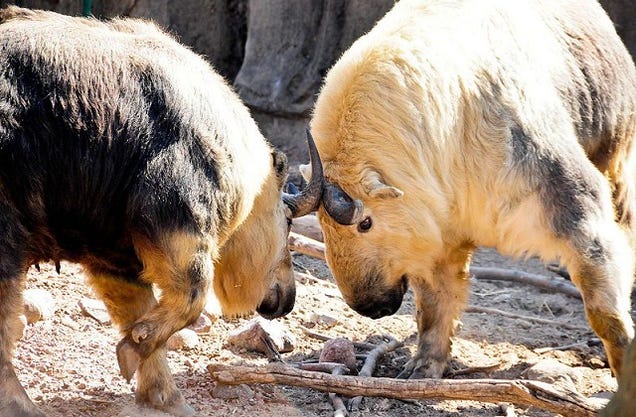
Why This Strange-Looking Animal Has A Nose Like A Penguin's Foot

This weird-looking thing is a Sichuan takin. It’s what happens when you let a bunch of sheep loose on the mountain ranges of Tibet for a few thousand years. It has a huge schnoz for the same reason the penguin has a unique set of


feet. Find out what these unique animals have in common.

A takin weighs over six hundred pounds and has horns like butcher’s hooks. It would probably be a lot scarier if its nose didn’t look like it was wearing a bigger, plusher version of itself as a nose-cozy. These animals have giant schnozes, and when scientists looked into the matter they found that the noses have something in common with an animal as unlike the takin as it is possible to be.

Penguins spend their days placing their bare feet directly on ice, without those feet freezing off. Although there are fish that manufacture a kind of “anti-freeze” in their blood to keep from freezing solid, penguins don’t have the same internal chemistry. Instead both penguins and takins have internal plumbing. By constantly circulating blood through their feet, penguins can keep their feet a couple of degrees above freezing. The real problem is what happens when that blood comes back into the body. Heating it up again will drain the penguin of energy, and fast. So before the penguin’s blood rushes from their feet back into their body, it passes very close by the network of other blood vessels going out into the feet. These outgoing vessels are full of warm blood which cools down, and transfers its heat to the incoming blood. The cooled blood keeps the feet just-barely-warm-enough, while the incoming blood is warmed enough to not slowly drain the penguin of both heat and energy.

The takin, meanwhile, is insulated with hooves and hair. It doesn’t really have to circulate much of its blood in an area that’s exposed to the cold. However, it is vulnerable to the cold in a different area – its lungs. Taking in huge lungfuls of oxygen-poor, freezing-cold air could drain the takin of its energy or its body heat, or both. When scientists looked inside the takin’s giant nose, guess what they found? Again, there was a network of blood vessels. The blood in these vessels kept the takin’s nose at a tolerably warm temperature. More importantly, it heated the incoming lungfuls of air, keeping the takin as warm as possible.

Tuesday, May 5, 2015

Chinese tourism board criticised for animal cruelty after pushing pigs off bridge


A Chinese tourism board has made pigs fly.


The animals, each with a bright number painted on its side, were herded onto a ramshackle bridge overhanging Shiyan Lake in the popular tourist province of Changsha and pushed off.

Online users have been upset by the “cruel” stunt, organised by Shi Huang as part of local May Day celebrations, with many criticising the event after photos were published on state broadcaster CCTV’s Facebook page.

"They look like they were pushed not jumping through choice. Cruel,” wrote Hayley McDonough.

Another user, Kay Khine S L, wrote: “This is animal abuse!” Jo Metcalfe added: “This is beyond sick. What did these sentient beings do, to deserve such punishment”?

Organiser Mr Huang, who plans to make the event weekly despite reports that the local tourism board received complaints, claims the piglets are “carefully trained” to perform the “special stunt”.

He continued: “They get well rewarded with food and once they get over their nerves they clearly enjoyed it.

“Anybody who says it is cruel is clearly not well informed that pigs like water,” he told the Mail Online.