Thursday, April 26, 2012

Take A Look At The Basic Information On Fennec Foxes


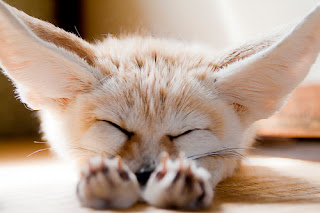
Fennec Fox
Fennec foxes are also known as desert foxes, since they survive in the Saharan desert. They are the smallest of the species of foxes, and several people wish to adopt them as exotic pets, because of their appearance. This is however, very rare, as they require special care and attention. Let's take a look at the basic information on fennec foxes, that includes its physical characteristics, its natural habitat, and its diet.

You should have legal permission to own a fennec fox as a pet.

Physical Characteristics:
  • The fennec fox is the smallest type of fox, with a body the length of about 9.5-16 inches. It has 6 inch long ears. It has a cream colored, furry body, with a black-tipped tail.
  • Physical characteristics such as their long ears radiate heat, and thus, help them keep their bodies cool. Moreover, the long hair on their body keeps them warm in winters, and protects them from heat in summers.
  • In order to walk on the hot sand, fennec foxes' feet are covered with hair, that help them for this purpose. Not only that, these feet also help them in digging, as they live in underground tunnels.
Habitat and Lifestyle:
  • The habitat of the this animal is mainly in the Sahara desert, and also in other parts of North Africa.
  • Fennec foxes are primarily nocturnal animals. They adapt themselves to the heat of their habitat with this trait.
  • They live in communities of ten, since they are extremely social animals, and each community has its own territory. This territory is marked out by a male fennec fox's urine.
  • These animals are however aggressive too, primarily in the mating season, where they compete for a mate.
Diet:
  • The diet of fennec foxes is omnivorous. While they can survive on plants, they also need other items to prey on such as insects, reptiles and rodents. Their adaptation to the desert allows them to survive for long periods without any water.
Fennec Foxes as Pets
  • Since fennec foxes are social animals, they require a good amount of attention and personal care. However, they are not domestic animals, so you might have to keep an eye on them as much as you can. They easily escape a closed environment, by their exquisite diggings skills, and are even good climbers.
  • If you happen to take them out, keep a good hold on the leash as they are quick runners, and difficult to get hold of once they escape.
  • They are primarily nocturnal, but should be allowed to lie in the sun for a while, to maintain their health. Also, they are highly active, and should be give adequate space for them to follow their own exercise routine.
  • Fennec foxes do not give out any foul odors, as do some other pets, and for this purpose make great pets.
  • A kennel is the best way to house a fennec fox, especially when you are not around to supervise its activities. At other times, when you are around, you may bring it into the house and keep it in a dog crate.
  • When you decide to keep them outdoors, you should do so in an outdoor pen, with a fence around it, that goes several underground, so that they do not escape by digging.
  • As mentioned before, since these are wild animals, training them to live in a house can be a challenge. Tasks like litter training may take a while. To do so, you will have to bring it to a litter box several times in a day from its pen, to relieve itself.
  • On the other hand, if you find it doing so openly in any other part of your house, don't punish it. Just move it back outside.
  • Since its diet is omnivorous, it requires a premium quality dry dog or cat food. This should be supplemented with other foods such as crickets, meal worms, and other fresh fruits and vegetables.
  • Lastly, before you get one, find out if there is a veterinarian in your locality who will be able to treat it in case it has a health problem. They require vaccinations similar to dogs, particularly one against rabies, and other viruses.
  • Having fennec foxes undergo a health check up yearly is a good idea, to prevent them from heartworm, fleas, and perform other deworming techniques if required.
If you keep all these facts in mind, and if all these tips are followed, you can have a cute fennec fox for a pet, that will survive for up to 12-14 years, provided it is well cared for.

Monday, April 23, 2012

Different Species Of King Crabs Which Are Found In Seas All Around The Globe


King crabs are one of the most hunted sea dwellers. There are different species of these creatures which are found in seas all around the globe. They are also known as 'stone crabs' due to their appearance. They prefer to live in freezing cold waters, whereas other species of crabs are normally found in warmer waters. They are the largest amongst all kinds of crabs, and have a great commercial demand and importance. Some of their species are used as food by many people due to their size and taste. Japanese and American restaurants are famous for preparing king crab recipes. Around 40 species of king crabs are known till now. The most common are Red King crabs, Blue King crabs, and the Golden King crabs which are generally found in Alaskan waters.

Types of King Crabs

Red King Crab
The existence of these types of crabs is widely distributed in comparison to other species. They are generally found in the water bodies of Japan, and towards the north in the sea of Okhotsk. Scientifically, they are known as 'paralithodes camtschaticus'. They contribute greatly to the sea food business, and are widely bought and sold in the commercial market. They are also the most expensive amongst all crab types which are considered as food. They are the most difficult ones to catch, which is the primary reason for them being so highly expensive. Famous hunting grounds of Red King crabs are the Bering Sea and the Norton Sound, Alaska. Their outer covering can grow up to 11 inches, and their legs can grow up to 1.8 meters.

Blue King Crab
These types are usually hunted in Alaska. Their scientific name is 'paralithodes platypus'. The ones which are caught in the Pribilof Islands are the largest among the Blue King crabs. They have a brown-colored body, and have blue highlights. They exceptionally have big claws which seem really dangerous.

Golden King Crab
These types are also known as 'lithodes aequispinus', and are generally found in regions from the British Columbia to the Aleutian Islands, and also Japan. These are relatively smaller in size in comparison with other species. As their name suggests, they have a golden-colored outer covering.

Granular Claw Crab
These crabs are scientifically called 'oedignathus inermis'. They are usually found in large numbers across the Pacific coasts of USA, from California to Alaska. A feature that differentiates them from other species is the large number of eminences which are visible on the planate chelipeds and leg areas. They usually reside underneath purple-colored algae.

Rhinoceros Crab
These are also called golf-ball crabs, and are normally found in depths of about 10 - 75 meters. Their shell is triangular in shape, and approximately seven centimeters in length. There are numerous spines and bristle-like structures present on the legs of these crabs.

Scarlet King Crab
They are scientifically known as 'lithodes couesi', and are smaller in size. They are found in large numbers, which lessens their commercial value.

These are some of the known King crab facts. Their fishing is largely carried out in Alaska. Due to this reason, the government has implemented regulations on overfishing to save these King crabs from becoming extinct.

Sunday, April 15, 2012

Among The Most Primitive Living Creatures On Earth Are The Dragonflies

Dragonflies have been known to roam the Earth for about 300 millions years. Paleontology (study of fossils) records reveal that the largest fossil of dragonfly was found to have a wingspan of about 2 ½ foot from the Carboniferous Period. Evolution in these species for millions of years changed their characteristics. Presently, Costa Rica homes dragonflies having wing span of 7 ½ inches. These insects are commonly found near water bodies like ponds, lakes and slow moving streams and other wet lands. These are the common spots for them to lay eggs. It has been known that dragonflies dwell in almost all continents, except Antarctica. Most dragonfly species are found in tropical areas. , There are about 5000 species of dragonflies found in the world, 450 out of which dwell in the United States. Here are some important dragonfly facts.

Dragonfly - Interesting Facts

Feeding
Dragonflies are regarded as strict carnivores insects. Insects like mosquitoes, gnats, midges, ants, termites, bees, butterflies and flies are on the menu of these insects. They also feed on larvae, tadpoles and even tiny fish. Dragonflies nymphs (the first stage after hatching) love to feed on mosquitoes. An adult dragonfly can savor about 50 mosquitoes in a day while flying around, and this is a very important factor in the biological control of mosquitoes.

Water
Dragonflies dwell in healthy and breathable water, and because of this characteristic feature they are considered as indications of good water source. Water bodies that support submerged and emergent vegetation provide shelter to these insects. They spend a major part of their lives underwater as nymphs in their larval stage. Sometimes this period goes up to 3 years, depending on the types of species. Adult dragonflies' life span lasts for a very short time - about a month.

Wings
Dragonflies are equipped with two sets of wings, so they do not have to beat their wings simultaneously. They flap their wings at a rate of 30 beats per second. It is known that these fliers can reach a top speed of 100 km/h. Their flight is similar to that of a helicopter; they can fly forward, backward, up and down and they are also capable of hovering. Such flying skills are achieved by powerful flight muscles and wings that can move independently.

Eyesight
Dragonflies are able to distinguish between colored, ultraviolet and even polarized light. The feature enable these insects to detect reflection in water. Among the most unbelievable fact about dragonflies is that each of their compound eyes contain about 30,000 individual lenses. They are able to have a 360º field of vision due to their eyes' position.

Territory and Mating
Like most males in the insect world and the animal kingdom, male dragonflies are very particular about their territory. They stake their claim to a particular area alongside a river, pond and the likes. Often, it can be seen that two dragonflies chase each other. When it comes to mating, these insects undergo a complex process. What is normally seen in a mating, is a couple attached to one another and flying through the air.

Predators
Birds are the natural predators of dragonflies. Apart from birds, these insects are also preyed upon by fish, water beetles, frogs, spiders, lizards and even larger species of other dragonflies.

Dragonflies and Humans
Various facts about dragonflies are surrounded by myths that revolve around these harmless creatures. It was believed that dragonflies have deadly stingers and people were allergic to them. It was also believed that, these insects used to sew the eyes of people who slept outside. The truth is, these insects are not a threat to humans. No cases have been recorded of any stings or bites from dragonflies. Instead, they are beneficial to humans. They help in reducing the population of mosquitoes and other harmful insects. Dragonfly facts also have some funny stories attached to them. One of them was a belief that these insects were snake doctors. They have the ability to bring dead snakes back to life. Now that's a hilarious one!

Conservation
Along with other insects and animal species, dragonflies also face a threat of extinction. The British Isles have witnessed the complete extinction of almost three species of these insects. The remaining population has become rare and have been restricted to a few areas of the world. These species face a constant threat from habitat destruction, pollution, and other environmental degradation.

Some More Facts
  • Native American culture attributed these flyers as the souls of the dead
  • The wings of the insect have ridges like formation. These help the dragon fly to detect the slightest brush of wind to take flight.
  • The efficient speed and maneuverability that the insect achieves in its flight is because the front wings are slightly longer than the wings at the rear.
  • The insect's brain devotes 80% of its ability in controlling sight, and processing of image the insect sees.
  • When a dragon fly reaches its adult stage, it crawls out of water and its exoskeleton is cracked open exposing its abdomen. When the wings come out, they are still wet and fragile. So the wings dry up and harden over the next several days after which the insect gets ready to go airborne.
Dragonflies form a small but an important part in the ecosystem. In fact, all animals and insects contribute to ecological balance, in someway or the other. Knowing about the facts of different species of the animal kingdom makes us aware of the prime importance of every creature. The dragonfly facts that have been described above, have been put up with an intention which can be of some help in preserving and respecting these wonderful fliers!

Sunday, April 8, 2012

The List Of Extinct Animals: Galapagos Penguin

The Galapagos penguin is the third smallest species of penguin in the world and is the most distinctive as it lives further north than any other penguin species. The Galapagos penguin is thought to be most closely to the African penguin and the Humboldt penguin found along the coast of Peru and Chile.

While ninety percent of the world's Galapagos penguins live among the western islands of Fernandina and Isabela, they can also be seen on Santiago, Bartolome, northern Santa Cruz, and Floreana. The northern tip of Isla Isabella crosses the equator, meaning that these animals occasionally visit the northern hemisphere, and are the only species of penguin to do so.

The Galapagos penguin has a black head with a white border running from behind their eyes, around the black ear-coverts and chin, to join on the throat. Galapagos penguins have blackish-grey upperparts and whitish underparts, with two black bands across the breast, with the lower band extending down the flanks to the thigh.

Before they breed, the Galapagos penguins moult, and they may do this twice a year. While the Galapagos penguins are moulting, they usually stay out of the water. They are able to go to the sea for food rather than starve though since the water is so warm in their area. Since they moult right before breeding, Galapagos penguins are able to ensure that they will not starve during the moulting process.

The Galapagos penguin is a carnivorous animal, that like all other penguin species, survives on a diet that is only comprised of marine animals. Krill and small crustaceans make up the bulk of the Galapagos penguin's diet along with larger organisms including squid and various species of fish.

Because of the Galapagos Penguin's smaller size, it has many predators both in the water and also on when they are on dry land. On land, the Galapagos penguins must keep an eye out for crabs, snakes, owls, and hawks, while in the water they must avoid sharks, fur seals, and sea lions. The Galapagos penguin has also been severely affected by human activity around the archipelago.

On average, the Galapagos penguin breeds once a year, forming pairs that usually remain faithful to one another. The female Galapagos penguin lays two eggs which are incubated by both parents for up to 40 days, when only one of the eggs will usually hatch. The Galapagos penguin chicks are fed and kept warm by their parents and remain with them until the chicks are nearly a year old.

Today, the Galapagos penguin is listed as an endangered species as like many species found around the islands, they are endemic to the area and do not adapt well to sudden changes in their environment.

Thursday, March 29, 2012

To Know All About The Sea Lions Habitats And Lifestyle

Sea Lions are found in all climates, in both the north and southern hemispheres and every ocean with the exception of the Atlantic Ocean. The sea lion is often seen around the big harbors of the world where groups of sea lions gather together to feed and bask in the sun.

The sea lion generally lives in coastal ares where there is a good food supply and land close by for the sea lion to have a rest from swimming and hunting in the water. The sea lion has 4 flippers which the sea lion is able to turn around when on solid ground, allowing the sea lion to walk on land.

The sea lion is often a popular attraction at zoos and parks, where the sea lions are generally being trained to do tricks with hoops and balls. The sea lion is a popular animal due the intelligence of the sea lion and also because of the quirky character which many sea lion individuals possess.

Today there are seven different species of sea lion found in waters around the world, These are the Steller sea lion which is also known as the northern sea lion as it is found in the North Pacific Ocean, and the Steller sea lion is the largest sea lion species; the Australian sea lion which is a small species of sea lion found on the south and west coasts of Australia; the South American sea lion, also known as the southern sea lion and is found along the west coast of South America; the New Zealand sea lion which is also known as Hookers sea lion is found around the south island of New Zealand and also the sub-antarctic islands; the California sea lion is found along the coasts of the north Pacific and is believed to one of the most abundant and intelligent species of sea lion today; the Galapagos sea lion is found exclusively around the Galapagos islands and is thought to be a distant relative of the California sea lion.

The only other sea lion species around was the Japanese sea lion, which was thought to have become extinct sometime during the 1950s. The Japanese sea lion was thought to have been related to the California sea lion and became extinct through hunt and the introduction of commercial fishing.

Sea lions are sleek and generally carnivorous animals although sea lions are known to eat sea weed and aquatic plants at times. Sea lions are playful marine mammals and can be observed spending hours playing in the water.

Sea lions generally gather on rocky, coastal land to breed. About a year later, the female sea lion will give birth to a single sea lion pup. Female sea lions tend to give birth to their young on land but it is not uncommon for the female sea lion to give birth to the sea lion pup in the water.

Sea lion pups are nursed by the mother sea lion until they are about six months old. Baby sea lions learn to swim when they are a couple of months old and it is then that the baby sea lions will go out and learn to hunt with the mother sea lion.

Sea lions are often seen in large groups of sea lions. Sea lions hunt in groups and in pairs and group numbers increase during the mating season. There have been instances where sea lions have been aggressive towards humans in the water. These acts are thought to be because the sea lions either want to play or they are male sea lions displaying and enforcing their dominance within their terrritory.

Sea Lion Foot Facts

》The sea lion has flippers in place of where its feet would be in order to help the sea lion move through water quickly, a substance that is eight times denser than air.
》In each flipper of the sea lion there are five skeletal digits, like toes, that give the sea lion more movement in its flippers but these are not always visible.
》Some species of sea lion are able to rotate their back flippers forward, so they are able to actually walk on all four flippers when on land.
》Adult sea lions have five claws on each of their two front flippers which the sea lion use to hook onto prey and to give them more grip when walking on land.
》The sea lion uses its front flippers to propel itself through the water with the back flippers acting as stabilisers meaning that they are not used a great deal in swimming.

Sea Lion Teeth Facts

》The sea lion has between 34 and 38 teeth which include incisors, canines, premolars and molar teeth.
》The incisors at the front of the mouth of the sea lion are quite small but are very sharp and are used for biting down on and holding onto prey.
》The canine teeth that are found behind the incisors in the mouth of the sea lion are large, conical, pointed and often slightly curved and these do most of the hard work.
》The molars and premolars in the mouth of the sea lion can vary in number but are very similar and have a slightly cup-like shape.
》The teeth of the sea lion are designed for grasping and tearing rather than chewing food and its for this reason that baby sea lions shed their milk teeth before birth.

Wednesday, March 21, 2012

The Baboon Is A Terrestrial And Ground Dwelling Animal

Baboons are medium sized primates found in Africa, and are best known for their bright behinds! The two most common species of baboon in east Africa are the olive baboon and the yellow baboon. The baboon is generally found in more forested areas but is also commonly known to wander the African plains.

Habitat
Baboons are found in surprisingly varied habitats and are extremely adaptable. The major requirements for any habitat seems to be water sources and safe sleeping places in either tall trees or on cliff faces. When water is readily available, baboons drink every day or two, but they can survive for long periods by licking the night dew from their fur.

Behavior
Baboons usually leave their sleeping places around 7 or 8 a.m. After coming down from the cliffs or trees, adults sit in small groups grooming each other while the juveniles play. They then form a cohesive unit that moves off in a column of two or three, walking until they begin feeding. Fanning out, they feed as they move along, often traveling five or six miles a day. They forage for about three hours in the morning, rest during the heat of the day and then forage again in the afternoon before returning to their sleeping places by about 6 p.m. Before retiring, they spend more time in mutual grooming, a key way of forming bonds among individuals as well as keeping the baboons clean and free of external parasites.

Baboons sleep, travel, feed and socialize together in groups of about 50 individuals, consisting of seven to eight males and approximately twice as many females plus their young. These family units of females, juveniles and infants form the stable core of a troop, with a ranking system that elevates certain females as leaders. A troop's home range is well-defined but does not appear to have territorial borders. It often overlaps with the range of other baboons, but the troops seem to avoid meeting one another.

When they begin to mature, males leave their natal troops and move in and out of other troops. Frequent fights break out to determine dominance over access to females or meat. The ranking of these males constantly changes during this period.

Males are accepted into new troops slowly, usually by developing "friendships" with different females around the edge of a troop. They often help to defend a female and her offspring.

For the first month, an infant baboon stays in very close contact with its mother. The mother carries the infant next to her stomach as she travels, holding it with one hand. By the time the young baboon is 5 to 6 weeks old it can ride on her back, hanging on by all four limbs; in a few months it rides jockey style, sitting upright. Between 4 and 6 months the young baboon begins to spend most of its time with other juveniles.

Diet
Baboons are opportunistic omnivores and selective feeders. Grass makes up a large part of their diet, along with berries, seeds, pods, blossoms, leaves, roots, bark and sap from a variety of plants. Baboons also eat insects and small quantities of meat, such as fish, shellfish, hares, birds, vervet monkeys, and small antelopes.

Predators and Threats
The baboon's major predators are humans. Knowing that humans can easily kill or injure them when they are in trees, baboons usually escape through undergrowth. Males may confront other predators like leopards or cheetahs by forming a line and strutting in a threatening manner while baring their large canines and screaming. Baboons are fierce fighters, but a demonstration such as this can put the predator on the run.

The baboon is intelligent and crafty; it can be an agricultural pest, so is often treated as vermin. Trade in baboons as laboratory animals has increased in recent years.